Note
The same source code archive can also be used to build the Windows and Mac versions, and is the starting point for ports to all other platforms. Download the latest Python 3 and Python 2 source. Alternative Implementations. Gpg -verify Python-3.6.2.tgz.asc. Getting and Installing MacPython¶. Mac OS X 10.8 comes with Python 2.7 pre-installed by Apple. If you wish, you are invited to install the most recent version of Python from the Python website (current “universal binary” build of Python, which runs natively on the Mac’s new Intel and legacy PPC CPU’s, is available there. These instructions document the installation of Python 3. The version of Python that ships with OS X is great for learning, but it’s not good for development. The version shipped with OS X may be out of date from the official current Python release, which is considered the stable production version. Mac OS X specific services¶. This chapter describes modules that are only available on the Mac OS X platform. See the chapters MacPython OSA Modules and Undocumented Mac OS modules for more modules, and the HOWTO Using Python on a Macintosh for a general introduction to Mac-specific Python. $ pip2 -V # pip pointing to the Homebrew installed Python 2 interpreter $ pip -V # pip pointing to the Homebrew installed Python 3 interpreter (if installed) Virtual Environments ¶ A Virtual Environment (commonly referred to as a ‘virtualenv’) is a tool to keep the dependencies required by different projects in separate places, by creating.
Check out our guide for installing Python 3 on Windows.
Python 2 For Mac
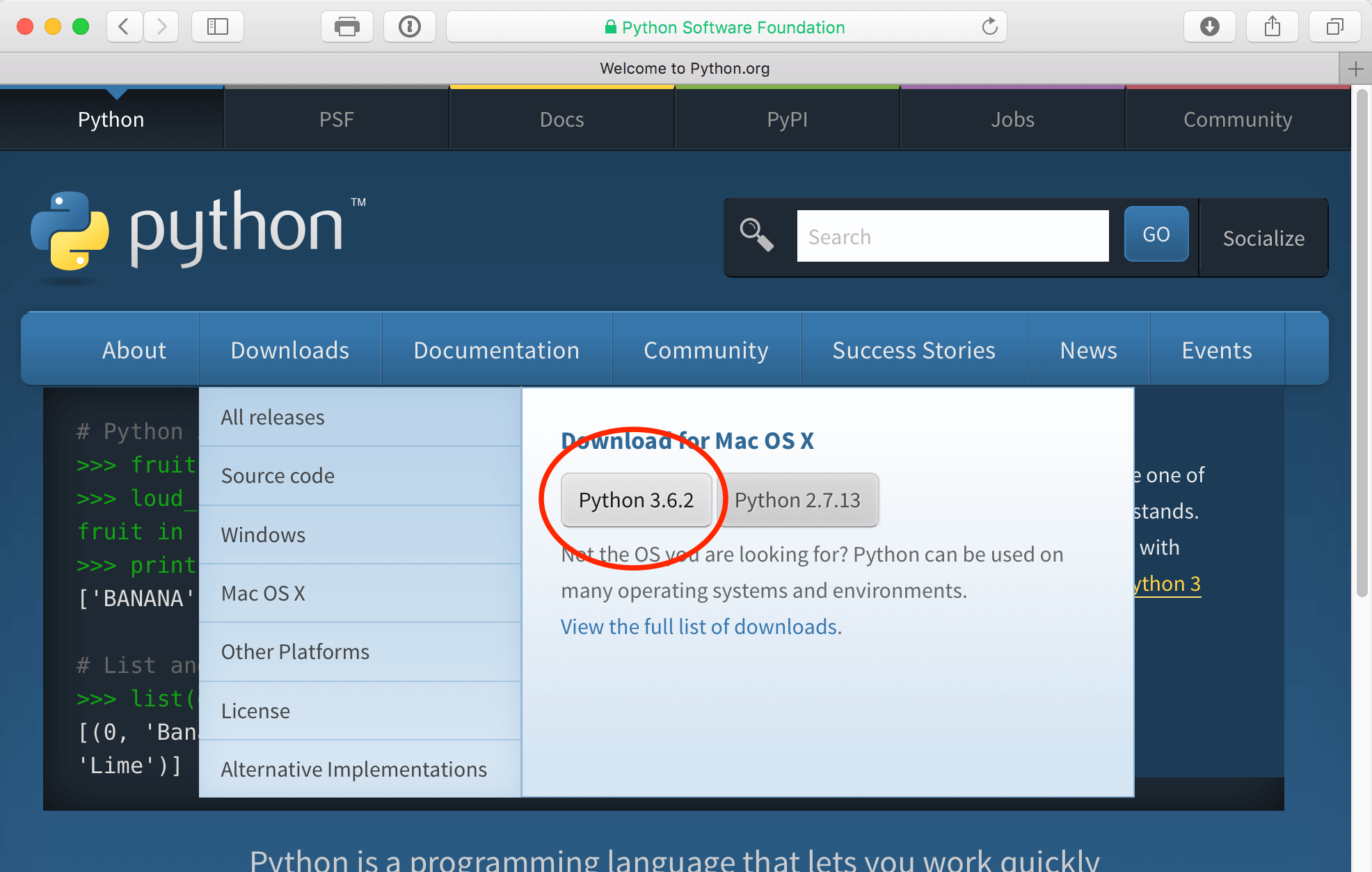
First, download the latest versionof Python 2.7 from the official website. If you want to be sure you are installing a fullyup-to-date version, click the Downloads > Windows link from the home page of thePython.org web site .
The Windows version is provided as an MSI package. To install it manually, justdouble-click the file. The MSI package format allows Windows administrators toautomate installation with their standard tools.
By design, Python installs to a directory with the version number embedded,e.g. Python version 2.7 will install at C:Python27, so that you canhave multiple versions of Python on thesame system without conflicts. Of course, only one interpreter can be thedefault application for Python file types. It also does not automaticallymodify the PATH environment variable, so that you always have control overwhich copy of Python is run.
Typing the full path name for a Python interpreter each time quickly getstedious, so add the directories for your default Python version to the PATH.Assuming that your Python installation is in C:Python27, add this to yourPATH:
You can do this easily by running the following in powershell:
This is also an option during the installation process.
The second (Scripts) directory receives command files when certainpackages are installed, so it is a very useful addition.You do not need to install or configure anything else to use Python. Havingsaid that, I would strongly recommend that you install the tools and librariesdescribed in the next section before you start building Python applications forreal-world use. In particular, you should always install Setuptools, as itmakes it much easier for you to use other third-party Python libraries.
Setuptools + Pip
The two most crucial third-party Python packages are setuptools and pip.
Once installed, you can download, install and uninstall any compliant Python softwareproduct with a single command. It also enables you to add this network installationcapability to your own Python software with very little work.
Python 2.7.9 and later (on the python2 series), and Python 3.4 and later includepip by default.
To see if pip is installed, open a command prompt and run
To install pip, follow the official pip installation guide - this will automatically install the latest version of setuptools.
Virtual Environments
A Virtual Environment is a tool to keep the dependencies required by different projectsin separate places, by creating virtual Python environments for them. It solves the“Project X depends on version 1.x but, Project Y needs 4.x” dilemma, and keepsyour global site-packages directory clean and manageable.
Mac Upgrade Python 3
For example, you can work on a project which requires Django 1.10 while alsomaintaining a project which requires Django 1.8.

Python 2 Machine Learning
To start using this and see more information: Virtual Environments docs.
Python 2 Path Mac
This page is a remixed version of another guide,which is available under the same license.
Comments are closed.